
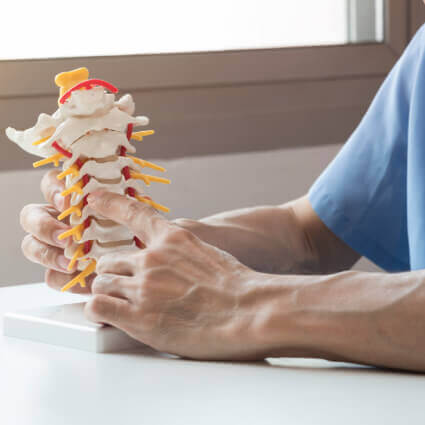
You’ve had an MRI, and now you’re staring at phrases like “disc protrusion” or “degenerative disc disease.” Confusing? Absolutely. Scary? It doesn’t have to be.
First: What Exactly is a Spinal Disc?
Between most of the bones in your spine sit small cushions called discs. Picture a jelly donut. A tough outer ring holds a soft, gel-like center, and together they absorb the forces of everyday movement.
Bulging Disc vs. Herniated Disc: What’s the Difference?
People often use these terms as if they’re the same. They’re not.
Bulging Disc – A bulge is broad. Picture pressing down on a cushion and watching its edge spread outward. A disc bulge extends beyond its usual boundary over a wider area.
Herniated Disc – A herniation is more localized. Disc material extends beyond its usual boundary in a smaller area, rather than bulging across a wider section.
Here’s the surprising part: neither finding tells us how much pain you should feel. Plenty of people have disc changes on imaging and no symptoms at all.
Why Do Discs Bulge or Herniate?
There’s rarely just one cause. Age-related changes can leave discs drier and less springy, a bit like a kitchen sponge that’s lost some moisture. An injury, perhaps from a fender bender on I-75 or I-285, or repeated strain from lifting and twisting, may also play a role. Symptoms can develop gradually or begin suddenly, and sometimes there’s no clear trigger. Long hours at a desk may aggravate discomfort without necessarily causing a disc injury.
When a disc irritates a nearby nerve, you might notice back or neck pain, sciatica, tingling, numbness, or weakness in an arm or leg.
Can Symptoms Improve Without Surgery?
Many people with a lumbar herniated disc improve without surgery. When there’s no significant or worsening weakness or other urgent warning sign, conservative care is often the first step. Surgery may be considered when symptoms remain disabling despite nonsurgical treatment or when serious nerve problems develop.
Depending on your examination findings, non-surgical spinal decompression may be considered as part of your care. It uses computer-controlled traction to apply a controlled stretching force to the spine. Evidence for traction in lumbar disc herniation is mixed, and lasting benefits are uncertain. An individualized plan may include targeted exercises and, when suitable, chiropractic adjustments. Referral to another provider may also be recommended.
“Your MRI is information, not your destiny. I want to understand how you move, what you feel, and what you want to get back to doing. Together with your imaging, that helps guide our next steps.”—Dr. JaGerran Knight-Bryant, D.C.
When Should You Seek Urgent Medical Attention?
Don’t wait if you develop difficulty passing urine, new loss of bowel or bladder control, numbness around the groin or “saddle” area, or sudden or worsening weakness in an arm or leg. Seek emergency medical care right away rather than waiting for a chiropractic appointment.
Bring Your Questions, and Your MRI Report
An MRI finding doesn’t automatically mean surgery comes next. At Mustard Seed Chiropractic, just off Windy Hill Road in Smyrna, our chiropractor will review your symptoms and available imaging, examine how you’re functioning, and explain the findings in plain language. We’ll discuss whether chiropractic care is suitable or whether referral is needed. Have an MRI report? Bring it along!